Post-Redevelopment Society Conflicts: Why Old and New Committees Clash
Published: 10th Apr 2026•By BlockPilot
Co-Op Housing Insights
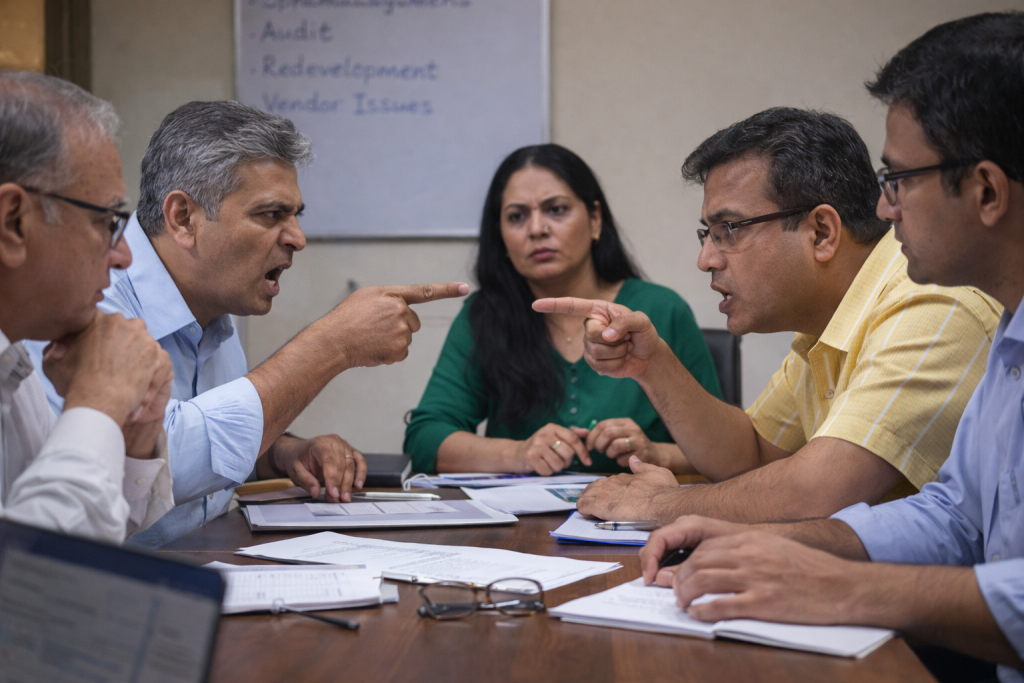
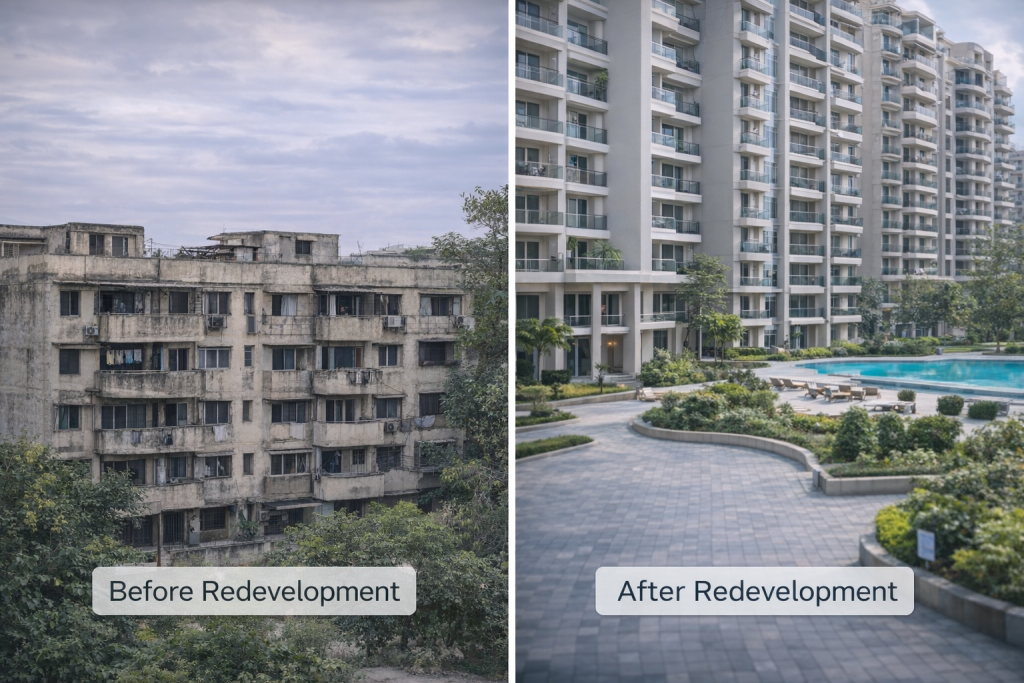
Redevelopment is often treated as the biggest milestone for a housing society. But many societies realise soon after possession that the real complexity begins only then. Conflicts between old and new committees are not exceptions but recurring patterns across urban India, especially in redevelopment-heavy markets like Mumbai. From BlockPilot’s experience working closely with housing societies, these clashes are rarely personal. They stem from gaps in governance, missing documents, and unresolved financial and operational decisions.
Why do old and new committees clash after redevelopment in a housing society? Old and new committees clash due to incomplete documents, unclear financial records, governance gaps, and a lack of structured transition. These issues lead to society audit issues, mistrust, and operational delays in housing societies.
1. Two Committees, Two Realities After Redevelopment
The old committee operates from experience built during years of redevelopment challenges. Negotiations, delays, member pressure, and compromise shape their decision-making. The new committee steps into a completely different environment with upgraded infrastructure, higher expectations, and a need for structured governance. This contrast creates friction. One group focuses on protecting past decisions, while the other pushes for change and efficiency. As observed in many housing societies, this clash is predictable when there is no structured alignment between the two. Without clarity in roles and responsibilities, governance becomes fragmented. Decisions get delayed, and routine operations turn into prolonged discussions. The issue is not intent but the absence of a defined transition framework.
2. Governance Gaps and Missing Documents Create Immediate Conflict
One of the most critical reasons for post-redevelopment disputes is poor documentation. Key documents such as approvals, contractor agreements, financial statements, and defect liability records are often incomplete or not systematically handed over. This directly impacts governance. New committees struggle to take control because they lack verified information. Old committees, on the other hand, rely on informal knowledge and past context that is not documented. This gap leads to confusion and societal audit issues. Housing society accounting mistakes often surface at this stage, especially when financial records are not properly maintained. Accounting errors in housing societies in India are frequently linked to this transition phase, where records are scattered, and verification becomes difficult.
3. Financial Ambiguity and Housing Society Accounting Mistakes
Financial disputes are one of the biggest triggers of conflict. During redevelopment, financial management is often handled under pressure, with multiple stakeholders involved. Post-redevelopment, these records come under scrutiny. New committees expect transparency, while old committees may have operated on trust-based systems. This mismatch exposes housing society accounting mistakes such as unverified expenses, missing invoices, and unclear fund allocations. These issues directly lead to society audit issues. When audits begin, discrepancies create mistrust and delay decision-making. Understanding how to avoid audit problems in societies requires structured accounting practices from the redevelopment stage itself. In many cases, the problem is not misuse but a lack of systems. However, without clarity, even genuine decisions are questioned, increasing friction between committees.
4. Institutional Memory vs Structured Governance
Old committees carry valuable institutional memory. They understand why certain decisions were taken, what compromises were made, and which issues remain unresolved. However, this knowledge often exists informally and is not captured in documents. New committees, focused on efficiency, rely on documented systems. When this knowledge gap is not bridged, misunderstandings arise. Old members feel their experience is ignored, while new members feel excluded from the critical context. This creates parallel governance structures. Decisions are influenced by informal inputs rather than defined processes. Over time, this weakens authority and slows execution. At BlockPilot, we consistently see that societies that convert institutional memory into structured documentation are able to avoid repeated conflicts and ensure continuity during this critical phase.
5. Operational Conflicts in a More Complex Asset
Post-redevelopment operations are significantly more complex. Modern buildings require structured management of MEP systems, security, housekeeping, and vendor contracts. Many housing societies are not prepared for this shift. Conflicts arise in areas such as vendor selection, maintenance budgets, and service standards. Old committees may prefer continuity, while new committees push for upgrades. Without proper documents and clearly defined scopes, vendor accountability becomes weak. These operational gaps increase costs and reduce efficiency. They also contribute indirectly to accounting errors in housing societies in India, as unclear contracts and poor tracking lead to financial inconsistencies. The absence of structured governance makes even routine operational decisions contentious, affecting overall society performance.
6. The Transition Problem: Why Alignment Fails
The core issue is not disagreement but a lack of transition planning. Redevelopment ends physically, but governance transition is rarely structured. Most housing societies do not define how responsibilities, documents, and decisions will be handed over. This leads to overlapping authority. Old committees continue to influence decisions, while new committees attempt to establish control. Without clarity, both operate with different assumptions. As highlighted in practical scenarios, societies that treat transition as a formal phase perform significantly better. They document unresolved issues, define decision rights, and ensure continuity without conflict. Platforms like BlockPilot help housing societies bring this structure into practice by aligning documentation, financial systems, and governance processes from day one, reducing the risk of disputes and audit complications.
Conclusion
Post-redevelopment conflicts are not caused by individuals. They are the result of missing structure, unclear governance, and incomplete documentation. Old and new committees are not in opposition. They are working within a system that lacks clarity and control. Housing societies that ignore this reality face prolonged disputes, society audit issues, and operational inefficiencies. Those that prioritise structured transition, proper documents, and transparent governance create stability and long-term value. With the right systems and execution approach, as enabled by platforms like BlockPilot, redevelopment can move beyond construction success into operational excellence. The difference is not effort. It is structured. The real success of redevelopment is not the new building. It is a housing society that functions with clarity, control, and confidence from day one.